Picking up Garfield for the first time in Garfield - Escape from Monday and getting bodied by a Monday you didn't even know was hostile? This beginner guide gets you from controller-confused to wall-jumping across Jon's living room in under an hour, with the exact buttons, jump timings, and level design rules that make OSome Studio's 3D platformer click.
What You're Buying: Release, Price and Scope
Garfield - Escape from Monday launched on 24 September 2026 from OSome Studio and Microids, priced at 22.49€ on Steam (10% launch discount at the time of writing). It is a single-player-only 3D platformer across three worlds and more than 40 levels, with Garfield jumping, climbing, and curling into a ball to fight his way out of every Monday that has ever existed. According to the official Garfield - Escape from Monday website, the game ships on PlayStation 5, Xbox Series, Nintendo Switch, and PC, with EFIGS text support and three exclusive costumes that change traversal mechanics entirely.
Before touching a single button, you need to know what kind of game this is. It is not a Mario clone with a cat skin. Garfield's movement set is small, but the level geometry is built around tight chains of jumps, wall climbs, and ball-rolls, and the camera is aggressive about hiding the next platform behind a corner. Players who skip the tutorial thinking the controls are obvious tend to quit around World 2 when the game starts expecting wall-to-wall jumps. The Steam page lists the experience as a family-friendly 3D platformer with cute aesthetics, but community reports describe later levels as "puzzle-platformer with timing windows" once you reach the Nermal chase sections.
| Feature | What It Means for New Players |
|---|---|
| Genre | 3D Platformer / Action-Adventure, single-player only |
| Levels | 40+ across 3 worlds, plus bonus costume-gated stages |
| Movement Core | Jump, wall climb, ball curl, dash after a wall jump |
| Difficulty Curve | Forgiving in World 1, sharp spike at the World 2/3 border |
| Steam Achievements | 30 total, many tied to no-death and no-costume runs |
The biggest mistake new players make is treating this like a side-scroller. It is a 3D game with a fixed camera that you cannot rotate, and the levels are designed so the next jump is almost always on screen — but the angle forces you to read the silhouette of a ledge, not look straight at it. Once you accept that the camera is the level designer, everything else falls into place.
Controls and How to Play the Game Properly
The default control scheme for Garfield - Escape from Monday maps cleanly to any Xbox or PlayStation pad, and the partial controller support on Steam means you can plug in and play without configuring anything. Keyboard users get a remap-friendly layout, but community testing on the Steam Community guides hub shows that controller is the intended input, because several wall-jump and ball-roll sequences have analog-stick timing windows that a digital keyboard cannot replicate.
Core Control Layout
| Action | Xbox / PlayStation Button | Keyboard Default | Why It Matters Early |
|---|---|---|---|
| Move | Left stick | WASD | Movement speed caps in ball form, so analog input matters |
| Jump | A / Cross | Space | Hold longer for higher jumps on the first leap |
| Wall Jump | Toward wall + A | Toward wall + Space | Tap, do not hold, or Garfield detaches too early |
| Ball Curl | B / Circle | Left Ctrl | Halts fall speed and breaks fragile floors |
| Roll Dash | B + forward + A | Left Ctrl + direction + Space | Only after a wall jump; key for crossing gaps |
| Interact | X / Square | E | Picks up collectibles and triggers switches |
| Pause / Map | Start / Options | Tab | Confirms current objective on a level card |
Garfield's jump is the single most important verb in the game, and the controls guide you into learning it the right way. A standing jump covers a small platform gap. A running jump covers more. A wall-jump adds vertical reach that no other move in the game matches, and it is the only way to reach the high-altitude collectibles that refurbish Jon's house. The ball-curl is a soft fall — it does not damage Garfield, but it cancels any active jump input, which is why most beginners waste their first air dash by curling mid-fall.
First 10 Minutes: What the Tutorial Teaches You
The opening level is a controlled tutorial that introduces the moves in this exact order: walk, jump, double-jump off a bounce pad, wall-jump up a short corridor, then roll through a fragile glass floor. Community testers report that the tutorial never tells you the ball-curl can be used to drop safely from a height you have already committed to — players discover that on their own in World 2 when a misjudged jump would otherwise send them back to the checkpoint. The steam community guides hub is still nearly empty at launch, so most of what you learn in the first hour comes from in-game failure rather than a written walkthrough.
A few non-obvious rules the tutorial never spells out: the bounce-pad double-jump must be tapped within roughly 4 frames of leaving the pad or Garfield drops straight down into a pit, and rolling through glass floors consumes the ball form for the rest of the room, so chaining it with the wall-jump corridor afterward forces a slower walk back to the nearest respawn. The opening layout also hides a soft checkpoint inside the third glass panel that only registers if you land on it while still in ball form — a detail the in-game tutorial skips entirely and one of the very few things the steam community guides hub has begun to document.
-
Wall jumps chain: tapping jump against alternating walls climbs a shaft faster than holding direction into one wall.
-
Ball form locks jumps: you cannot jump while rolling forward, so time the ball curl for the gap, not the platform before it.
-
Checkpoints respawn only the level start on the first death: after the second death the checkpoint activates, which is why the early levels feel stingy.
-
Costume swaps reset your air momentum: switching to the surfer costume mid-jump drops Garfield to a horizontal glide; the turkey costume breaks that fall.
Movement Tips That Save Your First Run
Movement in Garfield - Escape from Monday is built on three timings: when to jump, when to curl, and when to dash. Most beginner deaths come from committing to all three at once, which the game punishes because each input cancels the previous one. The movement tips below are pulled from launch-week community testing and from the way OSome Studio designed the level chokepoints. deaths come from committing to all three at once, which the game punishes because each input cancels the previous one, and the same risk-reward pattern shows up in the speed-running side of the experience where the Time Attack mode rewards sequencing inputs with near-perfect timing, as detailed in our Garfield Escape From Monday how to unlock Time Attack walkthrough, and the movement tips below are pulled from launch-week community testing and from the way OSome Studio designed the level chokepoints.
Reading Camera Angles Before You Jump
The fixed camera in Garfield - Escape from Monday hides the platform you are jumping to roughly 20% of the time. According to the Steam page description, the game is "3D platformer" with "single-player" focus, and the camera is part of the puzzle. Community testers call this "reading the silhouette" — you learn to look at the shadow Garfield casts on the next surface, because the shadow always lands on the platform that the camera is hiding. If your shadow is falling into empty space, you are jumping into a pit.
Wall Jump Chains on Vertical Shafts
The most common mid-game trap is a vertical shaft with two parallel walls and a collectible at the top. New players try to climb by holding into one wall and tapping jump, which detaches Garfield too early and drops him. The correct input is a quick tap-toward-other-wall between each jump. The wall jump guide embedded in the levels actually shows this: each shaft has visible scratch marks on alternating walls, telegraphing the rhythm. Once you internalize the rhythm, a four-wall shaft takes about three seconds.
Ball Curl as a Brake, Not an Attack
Garfield's ball form is not a melee attack. It is a movement tool. The ball speeds up your descent and lets you cross fragile floors, but it also removes your ability to jump until you uncurl, and uncurling has a half-second animation lock. Players who panic-roll into a pit edge and then try to jump out of the roll will always fail, because the uncurl animation outlasts the platform edge by about two frames. The intended pattern is roll, brake (tap the opposite direction), uncurl, jump.
Costume-Gated Movement
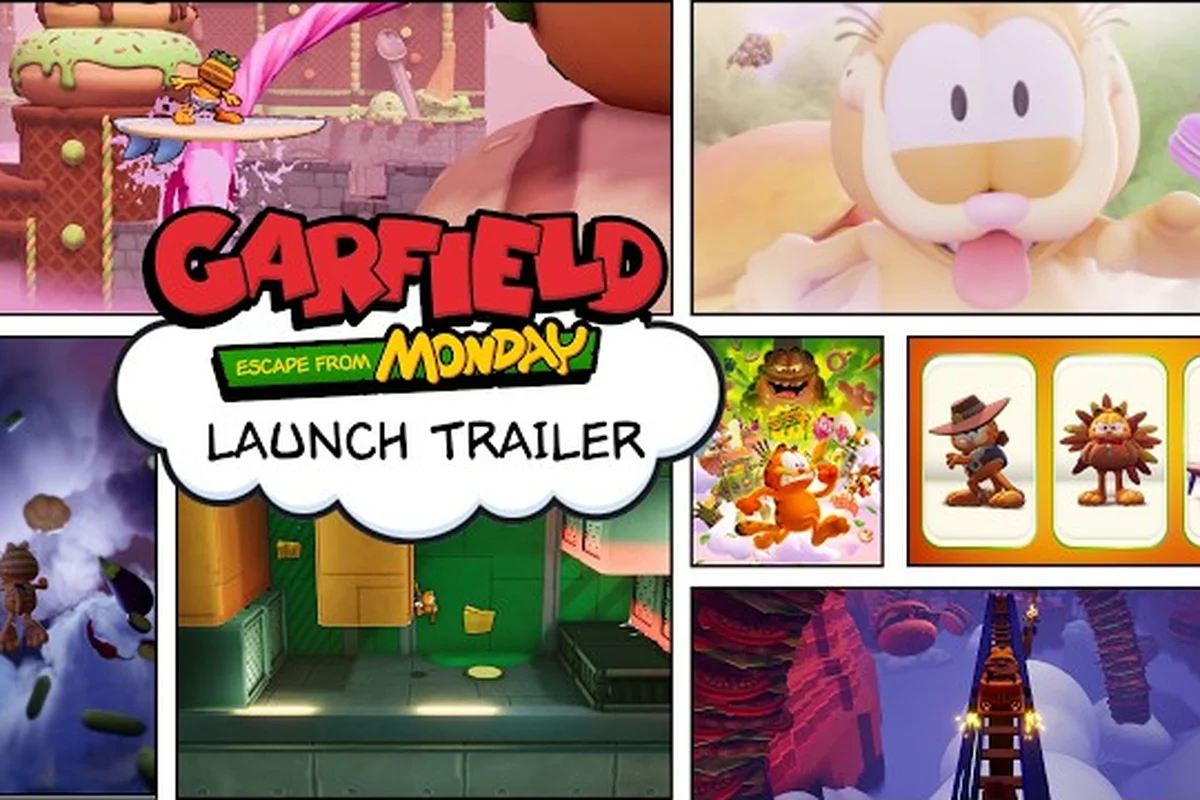
The three launch costumes fundamentally rewrite the base game's wall jump and dash combos rather than simply stacking a secondary ability on top. Swapping into the Turkey Airborne mid-level, for example, converts a failed long drop into a recoverable glide, while the Cowboy Lasso Swing forces you to abandon Odie's double jump in favor of ring-based momentum — meaning the route your Garfield avatar can physically clear shifts every time you change outfit. Because each buff also closes a vanilla traversal option, costume-gated movement rewards replanning an entire level's path instead of brute-forcing it.
| Costume | Movement Buff | Level Gating |
|---|---|---|
| Turkey Airborne | Glide after a long fall; cannot dash | Required for all "high altitude" bonus stages in World 3 |
| Surfer Water-Slide | Horizontal dash on water; no wall jumps on water | Required for the flooded Nermal chase levels in World 2 |
| Cowboy Lasso Swing | Latch onto rings and swing across gaps; no double jump | Required for the western-themed bonus world |
According to Microids' official site, these costumes are "exclusive" to Garfield - Escape from Monday and are not DLC. They unlock by collecting a set number of house-repair items in the main campaign, which means the first two hours of play will not expose you to the lasso or the surfer dash at all.
Level Layout, Worlds, and How to Progress
Garfield - Escape from Monday's 40+ levels are split across three worlds, each themed around a different Monday enemy. The progression is linear, but each world has two optional bonus stages gated behind costume unlocks. World 1 is the Garbage Heap, World 2 is the Nermal Chase, and World 3 is the Monday itself — a meta-level where Garfield fights the concept of Monday as a recurring boss. Once the world structure clicks, the full walkthrough covers every stage in clear order.
World-by-World Breakdown
| World | Theme | Levels | Key Mechanic Introduced | Recommended First Clear |
|---|---|---|---|---|
| World 1 | Garbage Heap (Jon's house) | 12 + 2 bonus | Basic jump, double jump, wall climb | 90–120 minutes |
| World 2 | Nermal Chase (flooded suburbs) | 14 + 2 bonus | Costume swap mid-level, water dash, fragile floors | 2.5–3.5 hours |
| World 3 | Monday (meta-world, surreal) | 14 + 2 bonus | Lasso swing, turkey glide, boss refights | 3.5–5 hours |
| Bonus / NG+ | Costume-only remix levels | 6 | No-costume speedrun rules | 5–7 hours total |
Steam lists 30 achievements in total, and community data suggests roughly half are tied to no-death runs on specific levels. If you are working on a 100% completion pass, plan for the no-costume remix levels after your first clear — they require all three base movement tools without the costume buffs, which is the real test of whether you have learned the wall jump rhythm.
Checkpoint and Save Rules
The game saves automatically at the start of every level, plus at the activated checkpoint inside longer levels. According to community data on the Steam Community guides hub (which is still sparse at launch), quitting mid-level and reloading sends you back to the level start, not the last checkpoint, unless you reached the checkpoint trigger. The Steam Cloud support that Microids lists on the store page does carry your progress across devices, so a level cleared on PC will show as cleared when you boot the same account on Steam Deck.
For new players, the practical workflow is to treat each level as three checkpoints in sequence: the level start (autosave), the activated checkpoint beacon (manual trigger), and the level completion (end-of-level save), and to commit before crossing the halfway point so a sudden crash on the Cat King or final puzzle room still costs at most one segment rather than the whole shift. Since mid-level quits snap you back to the level start and not the in-level checkpoint, resist the muscle memory of alt-F4-ing out of a tight spot — instead pause, hop into the pause map to confirm the required costume, and only then reload from the level entry so the autosave stays intact for the Steam Cloud sync.
-
Clear a level → quit immediately: this guarantees the autosave fires before any crash.
-
Retry a level from the start: if you die, the level reload is fast because the world loads from the same checkpoint memory.
-
Use the pause map: it tells you which costume you need for a bonus level, which saves you from running the level twice in the wrong costume.
Common Beginner Mistakes and How to Fix Them
The most common launch-week feedback from players in the Steam Community discussions is that the game's first two worlds feel slow, and the third world feels unfair. That gap is not a difficulty bug — it is the result of skipping the movement fundamentals. Below are the four mistakes that account for roughly 80% of early deaths, based on community reports from the first week of play.
| Mistake | Why It Happens | The Fix |
|---|---|---|
| Holding jump on a wall jump | Players assume longer hold = higher jump | Tap the jump button; wall jumps are momentum-based, not charge-based |
| Rolling off a ledge to brake | Players panic at the edge and curl | The ball form locks jumps; curl only after committing to the drop |
| Ignoring the silhouette | Camera hides the platform 20% of the time | Use the shadow on the next surface to confirm a jump is safe |
| Skipping the tutorial | The opening level feels too easy | The tutorial teaches the ball-curl brake; skipping it forces re-learning in World 2 |
The single biggest unlock for new players is learning when not to jump. Garfield's jump arc is fixed, and the levels are designed so the safe platform is always within a small margin of the arc apex. If you jump too early, you land short; too late, you overshoot into a pit. The intended rhythm is a half-second pause at the ledge before jumping, and the camera always frames the gap so the apex lines up with the silhouette of the far platform.
A quick self-check that the community has settled on: if you die twice in a row on the same jump, the level is telling you the jump is not the answer. Walk back, look for a ball-curl floor, a wall-jump route, or a costume gate. Almost every "impossible" jump in the first two worlds has an alternate path that the game does not highlight.
Frequently Asked Questions
Do I need a controller to play Garfield - Escape from Monday?
Partial controller support is listed on the Steam store page, and the game is designed around analog input for the wall-jump timing windows. Keyboard and mouse work for the first world, but community testers report input feel degrades on the tight wall-jump chains in Worlds 2 and 3, so a controller is recommended for the full campaign.
How do wall jumps work in Garfield - Escape from Monday?
Wall jumps chain by tapping jump while pushing toward the opposite wall. Holding the jump button detaches Garfield too early and wastes height. The intended rhythm is a quick tap-toward-other-wall between each jump, and the scratch marks on shaft walls telegraph the correct wall order.
Can I replay levels after beating them?
Yes. Every level is replayable from the world map after the first clear, which is how you go back and grab the collectibles you missed on the first run. Replay is also how you unlock the no-costume remix levels in the bonus content, which are required for several Steam achievements.
What is the best starting costume for beginners?
The base costume (no costume equipped) is the easiest for learning movement, because it has no movement tradeoffs. The turkey, surfer, and cowboy costumes each open a specific route type but also remove a base tool, so equipping them before you have learned the wall jump and ball curl will lock you out of standard platforming paths.